
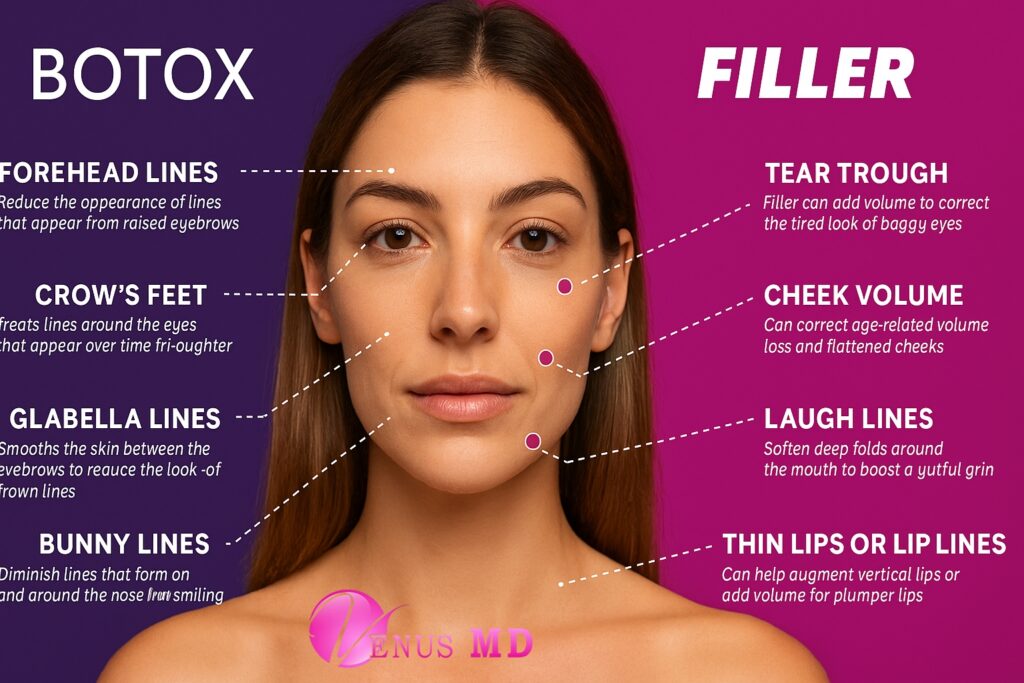
Botox and dermal fillers are both popular minimally invasive treatments for facial rejuvenation, but they work in different ways. Botox relaxes targeted facial muscles that contribute to dynamic wrinkles, while dermal fillers restore or enhance facial volume and contour. At VENUS MD, a physician-led cosmetic surgery and medical aesthetics practice in Huntington Beach serving Orange County, treatment recommendations are individualized according to facial anatomy, treatment goals, and appropriate product selection.
What Is Botox?
Botox is an injectable treatment that temporarily reduces activity in selected facial muscles. By treating muscles responsible for repeated facial expressions, Botox can soften dynamic wrinkles such as frown lines between the eyebrows, horizontal forehead lines, and crow’s feet around the eyes. The goal is not to eliminate natural facial expression, but to reduce excessive muscle movement that contributes to visible lines while maintaining a refreshed appearance.
Treatment is performed with a very fine needle and typically takes only a few minutes. Most patients describe the injections as brief pinches with minimal discomfort. Results usually begin to appear within several days and continue developing over the following one to two weeks, with effects commonly lasting approximately three to four months before muscle activity gradually returns.
Botox has a long history of cosmetic use and is FDA-approved for specific aesthetic indications. Temporary redness, swelling, tenderness, bruising, headache, or asymmetry may occur after treatment, and less commonly temporary eyelid or eyebrow drooping can occur. Proper patient selection, dosing, facial assessment, and injection technique are important for reducing complications and achieving natural-looking results.
What Are Dermal Fillers?
Dermal fillers are injectable products used to restore volume, soften facial folds, enhance contours, and improve facial proportions. Unlike Botox, which works by reducing selected muscle activity, fillers add volume beneath the skin. Many commonly used fillers are made with hyaluronic acid, a substance naturally found in the body, and different products vary in softness, flexibility, lift, projection, and longevity.
Dermal fillers may be used to enhance the lips, restore cheek and midface volume, soften nasolabial folds or marionette lines, improve chin and jawline definition, restore temple volume, and address selected under-eye concerns. Product selection and placement depend on the anatomy of the treatment area and the desired result. At VENUS MD, filler treatment is planned to enhance facial balance and proportion rather than simply add volume.
Results from dermal fillers are usually visible immediately, although temporary swelling can make the initial appearance different from the final result. Depending on the product, treatment area, amount injected, and individual metabolism, results may last from several months to more than a year. Common temporary effects include swelling, redness, tenderness, and bruising, while uncommon but potentially serious vascular complications are also discussed before treatment.
Botox vs Fillers: Key Differences
The main difference between Botox and dermal fillers is how they work. Botox primarily treats wrinkles caused by repeated muscle movement, known as dynamic wrinkles, while dermal fillers restore volume, enhance facial contours, and soften folds or hollows that remain visible when the face is at rest. In simple terms, Botox reduces selected muscle activity while fillers restore or enhance volume.
Botox is commonly used in the upper face for forehead lines, frown lines between the eyebrows, and crow’s feet around the eyes. Dermal fillers are frequently used in the lips, cheeks, chin, jawline, nasolabial folds, marionette lines, temples, and selected under-eye areas. Some areas can be treated with either approach depending on the underlying anatomy, which is why an individualized facial assessment is important.
Botox results develop gradually and commonly last about three to four months. Dermal filler results are generally visible immediately and typically last longer, although longevity varies considerably depending on the product and treatment area. Both procedures generally require little downtime, and temporary redness, swelling, tenderness, or bruising may occur after treatment.
Both Botox and dermal fillers have established roles in cosmetic medicine when appropriately selected and administered. No injectable treatment is completely risk-free, so potential benefits, limitations, alternatives, and complications should be reviewed before treatment. VENUS MD emphasizes careful facial assessment, anatomy, conservative treatment planning, and individualized product selection.
Can Botox and Fillers Be Used Together?
Yes. Botox and dermal fillers are frequently used together because they address different aspects of facial aging. For example, Botox may be used to soften forehead or frown lines caused by muscle movement while filler may be used to restore cheek volume, enhance the lips, improve facial contours, or soften deeper folds.
When appropriate, combining Botox and fillers can provide more balanced facial rejuvenation than either treatment alone. The goal is not to eliminate every facial line or add unnecessary volume, but to create a natural result that maintains facial expression and proportion. Treatment should be customized according to the patient’s anatomy rather than following a standardized injection pattern.
Which Treatment Is Right for You?
Botox may be more appropriate when the primary concern is forehead lines, frown lines, crow’s feet, or other wrinkles caused primarily by repeated facial movement. Dermal fillers may be more appropriate for facial volume loss, thinning lips, flattened cheeks, nasolabial folds, marionette lines, chin or jawline contour, or facial hollows. Some patients benefit from Botox alone, others from fillers alone, and many benefit from a carefully planned combination.
The best treatment depends on the cause of the concern rather than simply where a line or hollow appears. During an assessment, facial movement, soft-tissue volume, bone structure, skin quality, and overall facial proportions can all influence the treatment plan. In some situations, skin resurfacing, RF microneedling, laser treatment, or a surgical procedure may be more appropriate than additional injectable treatment.
Personalized Consultations at VENUS MD
Everyone’s facial anatomy is different, which is why choosing between Botox and dermal fillers should not be based on a one-size-fits-all approach. During a consultation at VENUS MD, your concerns, treatment goals, facial anatomy, medical history, and previous treatments are reviewed. This helps determine whether Botox, dermal fillers, another treatment, or a combination approach is most appropriate.
Dr. Francois Bui or an experienced medical aesthetics provider will assess your facial anatomy and skin condition and explain the treatment options that best fit your goals. The recommended approach, expected results, limitations, alternatives, and potential risks are reviewed so that you can make an informed decision. If another medical aesthetics treatment or a surgical procedure would better address your concerns, those options can also be discussed.
Safety and comfort are important parts of treatment planning. Your medical history is reviewed to identify factors that may affect candidacy, and individualized preparation and aftercare instructions are provided when treatment is performed. The objective is a treatment plan that prioritizes appropriate product selection, natural facial proportions, and realistic expectations.
Botox vs Fillers: Choosing a Natural Approach
Botox and dermal fillers are different tools that can be used individually or together for facial rejuvenation. Botox is particularly useful for dynamic wrinkles caused by muscle activity, while dermal fillers can restore volume and enhance facial contours. Neither treatment is inherently better than the other because they address different anatomical concerns.
The most natural-looking results generally come from selecting the appropriate treatment for the underlying cause rather than simply treating every visible line or adding unnecessary volume. At VENUS MD, treatment planning emphasizes facial anatomy, balance, proportion, and individualized aesthetic goals. This approach allows injectable treatments to refresh the face while maintaining recognizable facial features and natural expression.
Botox vs Fillers FAQ
Q: What is the difference between Botox and fillers?
A: Botox temporarily reduces activity in selected facial muscles to soften dynamic wrinkles such as frown lines, forehead lines, and crow’s feet. Dermal fillers add or restore volume beneath the skin and can be used to enhance areas such as the lips, cheeks, chin, jawline, or facial folds. The appropriate treatment depends on whether muscle movement, volume loss, facial contour, or a combination of factors is causing the concern.
Q: Which lasts longer, Botox or fillers?
A: Dermal fillers generally last longer than Botox. Botox commonly lasts approximately three to four months, while filler longevity varies depending on the product, treatment area, amount injected, and individual metabolism. Some fillers may last several months while others can remain effective for more than a year.
Q: Can I get Botox and fillers at the same time?
A: Yes. Botox and dermal fillers may be performed during the same treatment session when appropriate. Because they address different concerns, they are often combined as part of a comprehensive facial rejuvenation plan, such as using Botox for expression lines while using filler to restore volume or enhance facial contours.
Q: Are Botox and fillers safe?
A: Botox and dermal fillers have established safety profiles when properly selected and administered by qualified medical professionals. Temporary swelling, redness, tenderness, or bruising may occur, and each treatment also has specific potential complications that should be discussed beforehand. VENUS MD evaluates medical history, facial anatomy, treatment goals, and appropriate product selection before performing injectable treatments.
Q: How much do Botox and fillers cost?
A: Cost depends on the treatment area, amount of product required, and individualized treatment plan. Botox is generally priced according to the number of units used, while dermal fillers are generally priced according to the type and amount of filler required. A personalized treatment plan and current pricing can be provided during consultation.
Q: Do Botox or filler injections hurt?
A: Most patients tolerate both treatments well. Botox injections are performed with a very fine needle and usually feel like brief pinches, while dermal filler injections may create temporary pressure or a pinching sensation. Topical numbing and fillers containing lidocaine may be used when appropriate to improve comfort.
Considering BOTOX® Cosmetic or dermal fillers in Orange County? VENUS MD is a physician-led cosmetic surgery and medical aesthetics practice in Huntington Beach. Schedule a consultation to discuss treatment options based on your facial anatomy and aesthetic goals.
VENUS MD
7561 Center Ave, Suite 32
Huntington Beach, CA 92647
(714) 839-8712
www.venusmd.com